
Frog AGV Systems: Picking & marshalling system

Frog AGV Systems created a layout for automating a picking and marshalling system for one of its clients. Another supplier has designed an automated rollcontainer building station, where rollcontainers are automatically loaded and eventually have to be loaded into trucks.
Central marshalling buffer
To decouple the continuous production of rollcontainers and the peaky dispatch of outbound trucks a central marshalling buffer is needed. A design of the layout has been made together with an AGV (Automatic Guided Vehicle) solution proposed by Frog AGV Systems. In order to validate the design Frog AGV Systems has asked Talumis to create a simulation model of the layout to determine its performance.
Objective
The objective for this project was to create a simulation model which is able to determine the proof of concept for the layout designed by Frog AGV Systems. The second part of the scope was to determine the amount of globally determine the amount of AGVs needed to be able to handle the peak hour without obstructing the continuous production or delaying the outbound trucks that need to be loaded.
Solution
Talumis has subdivided its approach into two phases. In the first phase, the goal was to determine the proof of concept without having to create a model for the whole layout. This was done by analyzing one ‘aisle’ for which assumptions were made concerning input orders and output orders that needed to be handled in an aisle. In the second phase, the complete layout has been implemented including existing inbound production locations and AGV control logic.
Phase 1
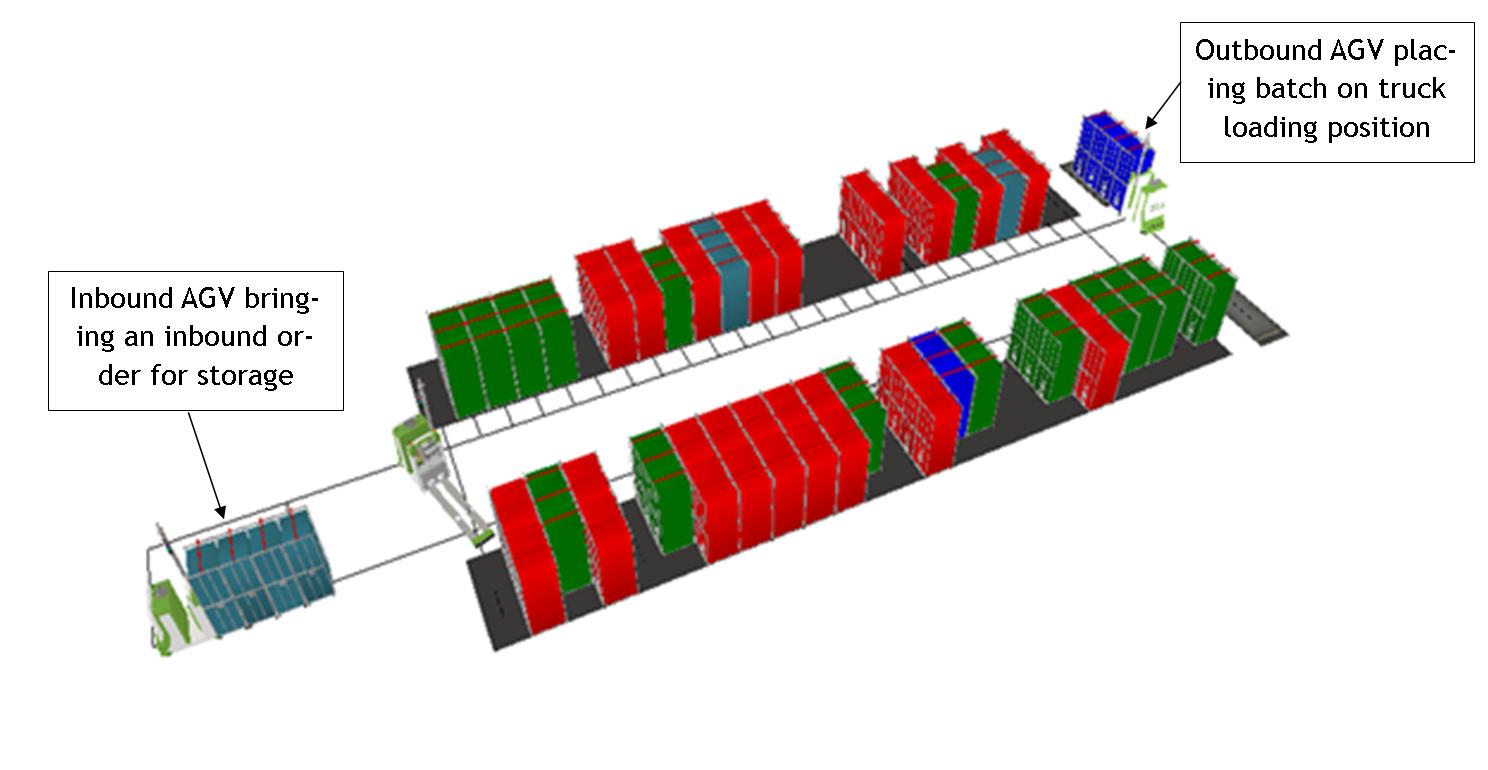
An aisle contains on average two AGVs which are occupied with outbound orders. Every two minutes an inbound AGV has to bring a set of rollcontainers and place it in the buffer area. Later it will be moved to one of the two loading positions. The internal logic of the AGVs is implemented such that the AGVs will wait when trying to enter each other’s area. A roulation system is used to avoid too much complex control logic for the AGVs. The main question was how much the internal AGV logic influences the capacity and if the needed capacity could be acchieved.
Phase 2
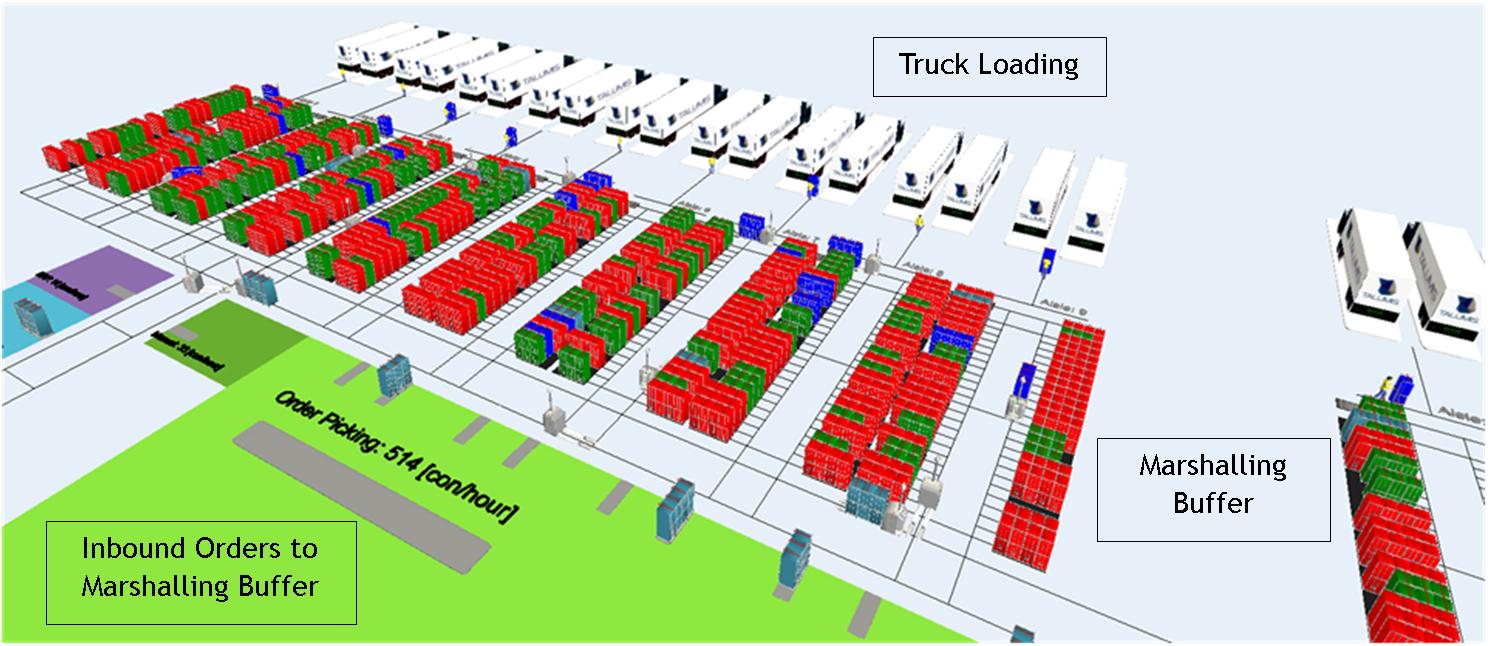
After a proof of concept the complete layout has been modeled including traffic logic, inbound and outbound order dispatching logic the available AGVs. Inbound orders are produced at different areas with a total combined capacity of 760 rollcontainers per hour. In the peak hour the outbound orders have a total of 1500 rollcontainers per hour that need to be loaded into trucks. As the capacity of the outbound orders is much higher than the capacity of the inbound requests, the simulation time frame to consider and analyze has been set to two hours. Each aisle has a dedicated outbound AGV which handles the outbound orders to supply the loading points where the rollcontainers are manually transfered into the trucks by an operator. The remaining AGVs are dedicated to be inbound orders. However, once an outbound AGV has loaded a truck within its loading time window it can help the inbound AGVs.
Results
The objective was to determine the feasibility of the layout and the amount of AGVs needed to fulfill the required constraints. The main constraints for a peak hour were:
• Keep up with an output of 1500 rollcontainers per hour where trucks have to be filled within 40 minutes.
• Try to retrieve a response time for the order picking process (inbound orders) with a maximum of 5 minutes.
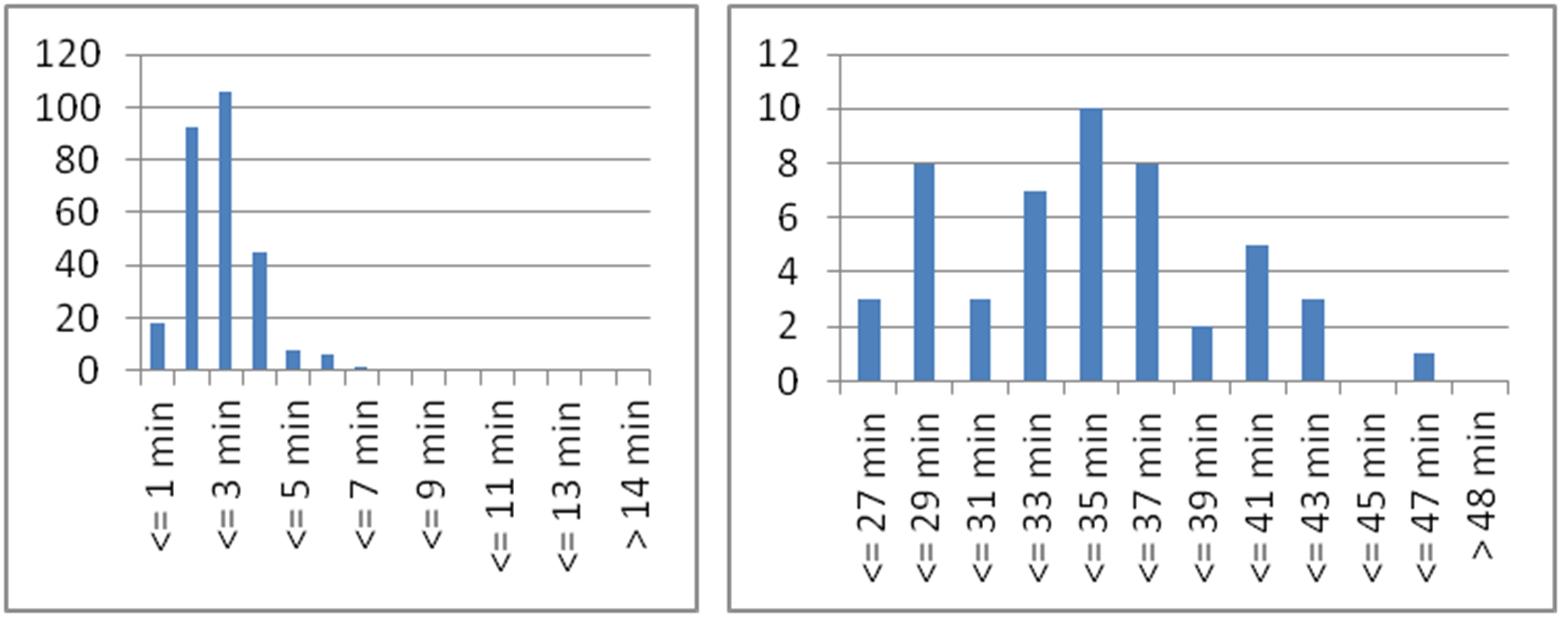
When the total amount of AGVs is set to 36 AGVs (14 inbound AGVs and 21 outbound AGVs), the response time of the order picking process is close to the needed boundary of 5 minutes. Also, the truck loading time is well enough within the 40 minutes.
This project is a perfect example of how a complex logistic system can be tested beforehand and where simulation can support in validating a ‘proof of concept’. Besides the validating purpose, simulation gives insight in the behavior of the system and leads to new ideas concerning implementation and control.


